
Mahindra & Mahindra (M&M) delivered a stronger-than-expected operational performance in the October-December quarter (Q3) of 2024-25 (FY25), driven by solid growth in its automotive (auto) and farm equipment segments. Higher volumes improved operating leverage, expanding margins.

With liquidity crunch hitting operations, many finance companies have put the brakes on sanctions in the third quarter in the aftermath of the IL&FS crisis.

Shares of public sector enterprises have corrected by up to 22 per cent month-to-date until March 19, 2024. Analysts attribute this steep fall to the valuation exuberance seen after a sharp run in these counters last year and suggest investors remain selective regarding the stocks in this space. "The rally in public sector undertaking (PSU) stocks has been stretched and sharp, although it is somewhat justified by improvements seen in earnings, operations, balance sheets, and overall profitability.

Propelled by strong demand and lower costs, the country's largest airline, InterGlobe Aviation (IndiGo), reported solid operational performance in the 2024-25 (FY25) October-December quarter (Q3). While demand was driven by the festival season, year-end increase, and higher consumer spending, lower fuel and rental costs helped deliver a beat at the operating profit level.

Tata Motors on Wednesday reported a 22 per cent fall in consolidated net profit to Rs 5,578 crore for the third quarter ended December 2024, impacted by s decline in revenue from its passenger and commercial vehicles divisions. The company had posted a consolidated net profit of Rs 7,145 crore in the same quarter last fiscal, Tata Motors said in a regulatory filing.

Tata Consultancy Services (TCS) on Friday reported a 9 per cent growth in net profit at Rs 12,434 crore in January-March quarter of FY24, helped by improved margin and strong performance of its India business. The largest software services exporter had reported a post tax profit of Rs 11,392 crore in the same period of the preceding fiscal. In the entire FY24, the company's net profit surged 9 per cent to Rs 45,908 crore, while the revenue rose to Rs 2,40,893 crore from Rs 2,25,458 crore registered in FY23.

While margins contracted by 30 basis points on y-o-y basis, they fell a sharper 120 basis points on a sequential basis to 16.8 per cent. Profitability was impacted adversely due to subdued demand, tepid realisations in commodity sectors, and negative operating leverage.

'The market's nervousness ahead of anticipated US tariffs has led to a significant downturn in Indian equities.'
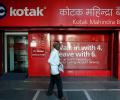
Kotak Mahindra Bank's net interest margin is likely to swell after the Reserve Bank of India (RBI) lifted its restrictions on the private lender that barred it from issuing fresh credit cards and onboarding new customers through digital mode, brokerages said on Thursday. The bank's net interest margin (NIM) has seen a decline of over 35 basis points (bps) since the restrictions were imposed by the regulator in April 2024.

Big, listed FMCG (fast-moving consumer goods) companies such as Hindustan Unilever, ITC, Nestl, and Britannia have been top-performing stocks on the bourses in recent weeks. The Nifty FMCG index, which tracks the share prices of the country's top 15 listed FMCG companies, is up 1.9 per cent month-to-date in May compared to a 2.4 per cent decline in the benchmark Nifty 50 in the period.

Against the Reserve Bank of India's (RBI's) projection of 7.1 per cent, India's first quarter (Q1) 2024-25 (FY25) gross domestic product (GDP) growth came in at 6.7 per cent. This is in line with market expectations and significantly lower than the 7.8 per cent recorded in the fourth quarter (Q4) 2023-24 (FY24) and 8.2 per cent in Q1FY24. The quarter witnessed decreased government consumption and investment spending due to the parliamentary election.

Private sector banks that announced their earnings for the October-December quarter (Q3) of 2024-25 (FY25) reported a rise in credit costs due to higher provisions, mainly for unsecured retail loans.

IT services firms' revenue growth in the fourth quarter will be affected by macro-driven headwinds, lower working-days, and the fact of the three-month period being low season. Analysts are expecting FY24 growth to be muted. Revenue growth will decline 600-700 basis points to 10-12 per cent for FY24, said a CRISIL Ratings report. The 10-12 per cent growth rate is a fall from the 18-20 per cent expected in FY23 and around 19 per cent growth in FY22, the highest in eight years, said the CRISIL Ratings report.

Indian Hotels reported strong consolidated revenue growth of 29 per cent year-on-year (Y-o-Y) in the third quarter of the current financial year (Q3FY25), led by revenue per available room, or RevPAR, growth of 15 per cent. The average room rate, or ARR, was up 13 per cent and occupancy improved 120 basis points (bps) Y-o-Y on a standalone business. Like-for-like revenue growth was 15 per cent Y-o-Y, while TajSats (airline catering) grew by 18 per cent Y-o-Y.

Escalating trade tensions amid a tariff war after Donald Trump took over as President of the United States (US) could adversely impact global growth and fuel inflation, an article on the "State of the Economy" in the Reserve Bank of India (RBI) monthly bulletin said.

The EIU said in a report on Wednesday forecast that the real GDP grew by 1.6 per cent quarter-on-quarter in India, but noted that this uptick was largely owing to base effect.

The growth was primarily driven by domestic investments, which accounted for 60 per cent of the total inflows during the first quarter of the financial year.

Wipro, TechM and HCL to lead sector growth in Q4, while Infosys to report soft quarter.

IT services major LTIMindtree reported a net profit of Rs 1,100 crore for the fourth quarter of financial year 2023-24 (FY24), down 1.2 per cent year-on-year (Y-o-Y) from Rs 1,141 crore in the same quarter last financial year. Revenue grew 2.3 per cent Y-o-Y for the fourth quarter to Rs 8,892.9 crore. Sequentially, revenue was down 1.4 per cent.

Public sector banks (PSBs) posted 16.1 per cent year-on-year (Y-o-Y) growth in net profit at Rs 39,974 crore during the June 2024 quarter. While net interest income (NII) showed subdued growth of 7.1 per cent, provisions and contingencies declined by 10.5 per cent Y-o-Y. This aided the bottom line to show steady growth.

Shares of Bajaj Finance surged over 6 per cent on Thursday after the diversified non-banking finance company reported an 18 per cent increase in consolidated net profit to Rs 4,308 crore for the December quarter. The stock rallied 6.33 per cent intraday to touch Rs 8,249.95 - a 52-week high -- on the BSE.

The financial numbers for 2023-24 (FY24) of the four pure-play listed asset management companies (AMCs) have enthused the Street. All firms listed robust growth in net profit and revenue both during the January-March quarter (Q4) of FY24, as well as in full FY24. The strong performance comes amid a positive growth environment for the sector, led by tailwinds such as sharp growth in assets under management (AUM) and robust performance in equity offerings.

'The steel industry expects the government to decide on safeguard measures from dumping post-Budget'

Currency volatility to have negative impact of 275 bps

Upstream majors ONGC and Oil India (OIL) results for the January-March quarter (Q4) of FY24 suggest better production in future. But OIL missed its own production targets although it delivered higher volumes and it disappointed the market in terms of Ebitda. ONGC reported standalone Ebitda of Rs 17,400 crore (up 7 per cent year-on-year or Y-o-Y) in Q4FY24, slightly below estimates due to other higher expenses.

Bharti Airtel is expected to see its highest revenue growth, and subscriber addition during the third quarter (October-December) of FY25 among telcos, said analysts. The telco's top line in Q3 may see the fastest sequential growth at 5 per cent compared to 3 per cent for Reliance Jio and Vodafone Idea (Vi). Airtel's annual mobile revenue growth would rise to 16 per cent, IIFL Capital said in an analyst note.

India's economic growth slowed to a 15-month low of 6.7 per cent in April-June 2024-25, mainly due to poor performance of the agriculture and services sectors, government data showed on Friday. The gross domestic product (GDP) expanded by 8.2 per cent in the April-June quarter of 2022-23. India, however, remained the fastest-growing major economy, as China posted a 4.7 per cent growth in April-June 2024.

Stock markets will be driven by domestic inflation data, ongoing quarterly earnings from corporates and global trends this week, analysts said. News flows around the general election would also be tracked by investors, market experts said.

The ongoing fourth quarter earnings season, global factors and macroeconomic data would guide the trends in the equity markets this week, analysts said. Markets would also take cues from trading activity of foreign investors, rupee-dollar trend and movement of global oil benchmark Brent crude. "Domestically, the next batch of Q4 earnings reports will drive stock-specific movements, Hero MotoCorp, Larsen & Toubro, BPCL, State Bank of India, Eicher Motors and Tata Motors are some of the big names in the list and the next phase of voting," said Pravesh Gour, senior technical analyst, Swastika Investmart Ltd.

This could fundamentally transform the industry that had been a major source of employment in countries like India and the Philippines.

Shares of Le Travenues, which operates online travel booking platform ixigo, soared 78 per cent on their market debut (June 18) and surged 80.4 per cent in the three days over their issue price. Ixigo has joined competitors EaseMyTrip and Yatra on the bourses. Analysts believe the blockbuster response to ixigo may lead to greater scrutiny of the financial performance of other online travel aggregators (OTAs) like Easy Trip Planners, and Yatra Online.

In the December quarter, Sensex earnings had contracted 5 per cent.

The country's largest software services firm, Tata Consultancy Services (TCS) on Monday reported a 14.9 per cent rise in consolidated net profit to Rs 9,246 crore for the March 2021 quarter.
Tata Motors reported a consolidated net profit of Rs 17,483 crore (adjusted for exceptional gains and losses) for Q4FY24, surpassing TCS' consolidated net earnings of Rs 12,434 crore. For the automotive major, this marked a 213.7 per cent year-on-year increase in the bottom line, from Rs 5,573.8 crore a year ago. In contrast, India's biggest IT firm saw a more modest Y-o-Y growth of 9.1 per cent in net profit, from Rs 11,392 crore.
The Indian equity market is likely to see one of its worst phases, with most sectors expected to report a decline in earnings or single-digit earnings growth in Q4 FY'09, a leading broking firm said in its report.

The broader market performance, however, is expected to be better by virtue of good performance of state-owned banks on a low base.

After lagging behind other segments in the automotive (auto) space over the past few years, two-wheelers are expected to reverse their volume underperformance. After witnessing a 36.3 per cent volume decline over the 2018-19 (FY19) through 2021-22 (FY22) periods, the sector staged a recovery in 2022-23 (FY23), with volumes rising 17 per cent. While volumes are still a quarter lower than the FY19 peak of 21 million units, a double-digit growth trajectory is expected to prolong.

Infosys Ltd on Thursday reported a 4.7 per cent rise in the September quarter net profit and raised revenue guidance after broadbased growth. Net profit of Rs 6,506 crore in July-September was up 4.7 per cent when compared to Rs 6,212 crore earnings in the same period last year. It was 2.2 per cent higher quarter-on-year, according to a company statement.

A Rs 525-crore contingency provision during the July-September period led to a 19 per cent fall in IndusInd Bank's share price on Friday (October 25). Contingency provisions are generally made when a lender expects more bad loans in the coming quarters. Shares of the bank on Tuesday (October 29) declined 1.53 per cent to settle at Rs 1,038.2 apiece on the BSE.

'The transition from payment banks to SFBs is only permissible for banks not owned by corporate entities.'
